
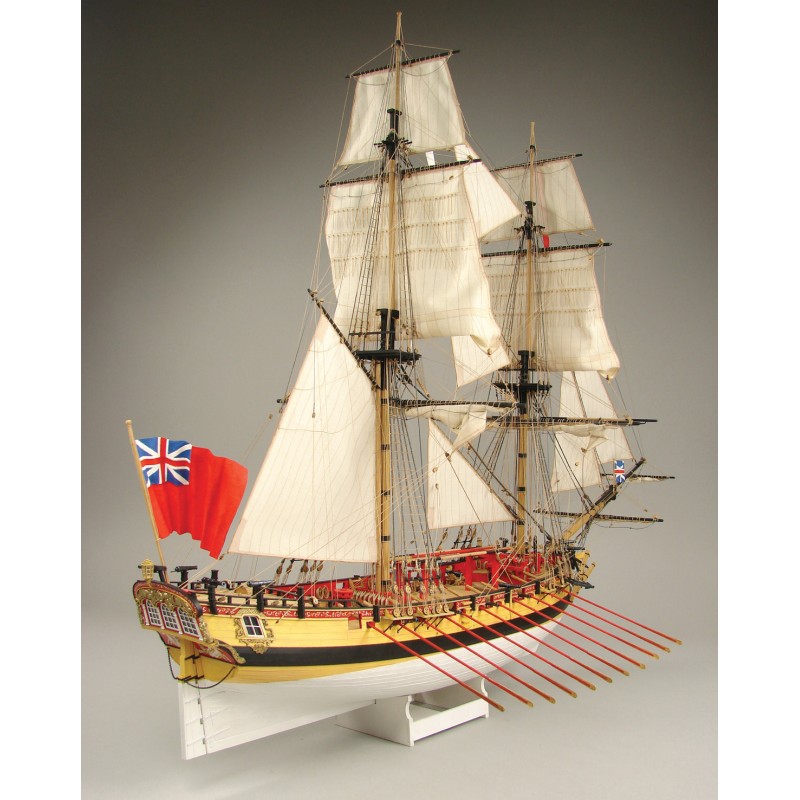


Name: HMS Wolf
Laser-Cut Cardboard Kit includes:
The two-masted sloop, Wolf, was a small military vessel dedicated to supporting military activities. She had rigging known as "snow", and so had an extra special mast, called a snowmast, which secured the mainmast gaff sail with the boom. Built in the yard of Chatcham, she was launched in 1754, two years before the outbreak of the Seven Years’ War. This war gave her the opportunity to participate in one of the spectacular actions of the British fleet - the attack on Le Havre and the destruction of the amphibious ships that were built to invade England. At dawn on April 7, 1759, the British began firing Le Havre with five bomb vessels which belonged to the squadron commanded by Admiral George Rodney. This squadron consisted of 3 battleships (two-deckers, 3 frigates and two sloops: HMS Carcass (14 guns) and HMS Wolf (10 guns), whose captain at the time was Hugh Bromedge. During the fire, at least 1,900 mortar bombs (weighing 93 - 197 pounds) and 1150 special fire-balls fell on the the city and the shipyard slipways. The invasion fleet wich was built there was completely destroyed, and also several fires were ignited in the city and the harbor. At the end of the hostilities, HMS Wolf underwent routine maintenance and repairs, and when the next war began, this time for the independence of the American colonies, she was sent to guard convoys, action against smugglers, as well as force recruitment of naval recruits. She therefore often visited the ports of Ireland and south-west England, where she was able to employ men off the streets and out of local taverns who were capable of serving in the Royal Navy. For example – On November 5, 1776 she held "captives" in Fowley. Three years later the same methods were used to provide "recruits" directly to the Royal Navy ships circling the English Channel. To this day, preserved in the records, are the penalties served out on the HMS Wolf for drunkenness, insubordination and rebellion with the characteristics of inappropriate behavior toward officers. For these transgressions the offenders were threatened with whipping - 12, 24 or more strokes. In 1781, the sloop HMS Wolf (now aged and leaking) was sold for L262.
Data sheet