
- Specjal offers
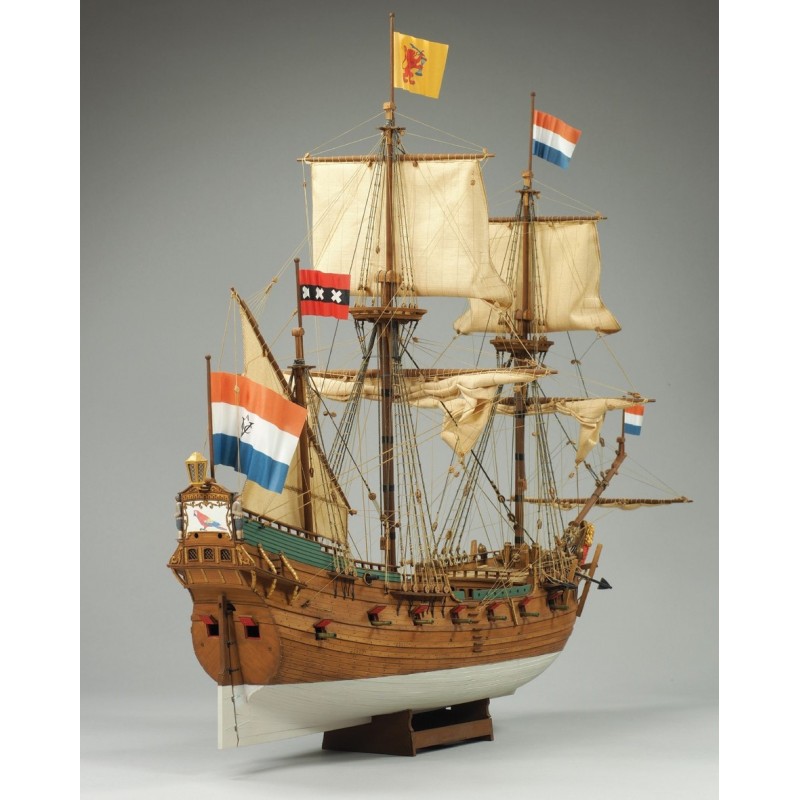


Name: Papegojan
Laser-Cut Cardboard Kit includes:
Papegojan (a parrot) was a pinnace armed with 16 guns. She was bought by Anton Monier in Holland in 1623 on Gustav Augusts’ order. Together with seven other galleons (Kristina, Tigern, Solen, Enhörningen, Mänen, Regnbagen, Pelikanen) and one more pinnace (Regnier) she sailed to Sweden in the summer of 1624. In 1627 she took part in a blockade of Gdansk in Poland. As the smallest Swedish ship she was involved in the battle at Oliva. She came back to the waters of the Bay of Gdansk in the following year to block Gdansk again. In 1629 she operated in the squadron assigned for blockade of Wismar. She was sunk in 1644. The Vasa’s dynasty reign in Sweden had lasted since 1523 when Gustav Eriksson was chosen to be a king. In 1544 the parliament announced the throne succession so after Gustav’s death his first son, Erik, became a new king. His brothers deposed him after a few years and next of them, Jan, has been known as another king of Sweden. He married Katarzyna Jagiellonka from the Polish royal family and their son, Sigismund, was elected to be a king of Poland in 1587 still being a successor in Sweden. He ruled over Poland as Sigismund III Vasa persuading a Swedish crown which he finally achieved in 1594. But in 1599 Karol, the third brother of Erik and Jan deposed him. Since 1611 his son, Gustav August, had been the next king of Sweden and solution of the family but political and religious conflicts had led to the war. Denmark, Poland, and Russia were treated as potential enemies of Sweden. The war with Denmark ended in 1613 but Sweden had to pay a huge ransom, however, the war with Russia was won in 1617. To control the Baltic trade and ports Gustav August needed to occupy the south and east coast of the sea with a well developed navy. Before 1620 it was a small-ship navy with mainly single deckers armed with 12-pounder guns. An ambitious plan of its development included contracts for the building of five heavy armed twodeckers, with the best known, but not the biggest, Vasa. Because a demand for new ships was higher than Swedish’s shipyards ability, some of them had to be bought abroad. The war with Poland lasted from 1617 to 1629. In 1625 Swedes seized Inflants but the returning 10 ships were sunk in the storm near Domenäs. Following year they occupied Pomerania and Prussia coming close to Gdansk. Finally, they did not manage to seize it but a blockade on the sea was established. On 28 November 1627 six Swedish ships fought against ten Polish ships. During the battle, known later as the battle at Oliva, Poles captured galleon Tigern and the other one, Solen, was blown up by her crew. Remaining four ships, Enhörningen, Mänen, Pelikanen and Papegojan sailed back to Älvsnabben and then to Stockholm. Swedish ships were back in the south Baltic in 1628. They blocked important ports in Poland and helped Danes in Stralsund occupied by Habsburgs’ army. In January 1629 Polish fleet sailed to Wismar so Swedish ships received order to establish a blockade there and after its downfall they captured all ships in the harbour. Sigismund III Vasa died and Gustav Adolf perished in the battle the same year. Some unsolved conflicts had been solved later in the same military matter by their successors. The Swedish navy became the most powerful in the Baltic whereas the Polish fleet almost disappeared.

Data sheet