
- Specjal offers
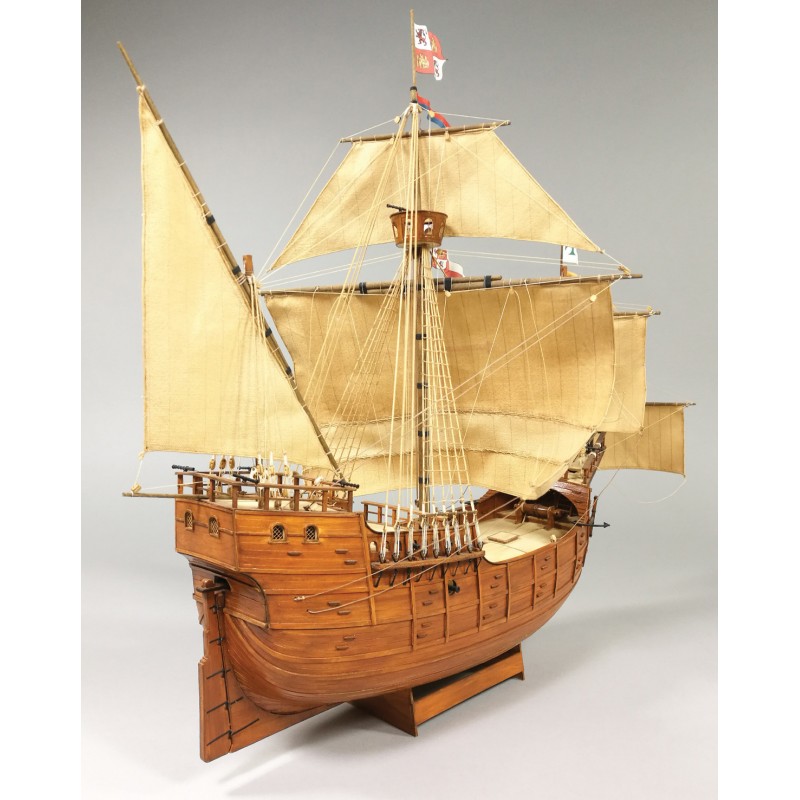


Name: Santa Maria
Laser-Cut Cardboard Kit includes:
On 3rd August 1492, from the harbor Palos de la Frontera, near the city of Huelva, three ships embarked on a journey that changed the world map, initiated the exploration of both of the Americas, Asia, Africa and the colonization of these continents. After seventy days of sailing, including through the Canary Islands where supplies were replenished, a small flotilla arrived at one of the Bahamas islands on 12th October 1492, an island which Columbus named San Salvador. The journey was full of tense moments, dashed hopes and threats of rebellion, but all low spirits were lifted when land was found. To the eyes of the sailors, the landscape appeared simply fabulous, a paradise, and the natives accepted them hospitably and favorably. During this expedition, Columbus explored several of the Bahamas islands, the northeastern coast of Cuba and the northern coast of Hispaniola (today's Haiti and Dominican Republic).Convinced that he had discovered China, Columbus sent a delegation in search of the Great Khan. On 24th December the Santa Maria ran aground on a reef, and attempts to rescue failed -damage to the hull caused her to sink off the coast of Hispaniola (Haiti). The crew of the sunken ship founded the colony "Navidad". Then on 16th January 1493 began the return trip home. Columbus sailed to Palos on 15th March, from whence he went to Barcelona to appear before Isabella and Ferdinand. He brought with him the first Indians, plants unknown to Europeans, parrots and gold. The great explorer undertook three more expeditions to the New World, during which he discovered the Antilles islands and the mainland - South America. During the fourth and last expedition in search of the cities of China, Columbus sailed to the coasts of what are now known as Honduras, Nicaragua, Costa Rica and Panama. Christopher Columbus died on 20th May 1506. Drawings of Columbus' ships were not preserved. From the various documents, engravings and paintings, historians concluded that Columbus had two caravels, Pinta and Nina, and the carrack, Santa Maria. A caravel is the type of ship with the so-called fore and aft rigged sails or lateen sails. The latest research shows that the Nina most likely had four masts, the first of which had a square sail, the other three, lateen.The carrack Santa Maria was a three mast ship, the first two masts carrying square sails and the last, lateen. The Nina accompanied Columbus on three trips to the New World and is sometimes referred to as his favorite ship.The units were armed with several guns of different caliber. The crews of the Columbus ships consisted of 90 men, with names being known of 87.

Data sheet