
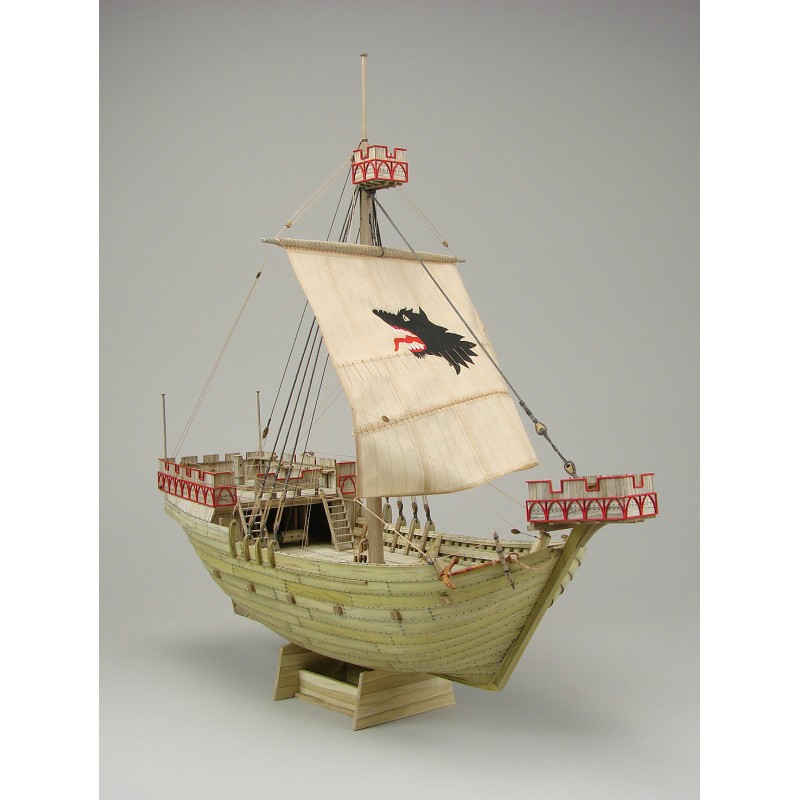
Wütender Hund - Kogge 1390
search
  • Wütender Hund - Kogge 1390
  • Wütender Hund - Kogge 1390
  • Wütender Hund - Kogge 1390
  • Wütender Hund - Kogge 1390
  • Wütender Hund - Kogge 1390
  • Wütender Hund - Kogge 1390
  • Wütender Hund - Kogge 1390
  • Wütender Hund - Kogge 1390
  • Wütender Hund - Kogge 1390
  • Wütender Hund - Kogge 1390
  • Wütender Hund - Kogge 1390
  • Wütender Hund - Kogge 1390
  • Wütender Hund - Kogge 1390
  • Wütender Hund - Kogge 1390
  • Wütender Hund - Kogge 1390
  • Wütender Hund - Kogge 1390

Wütender Hund - Kogge 1390

zł522.00
Quantity
Last items in stock

Name: Wütender Hund - Kogge 1390

  • Cat. No. ZL:050
  • Scale: 1:72
  • Lenght: 355 mm
  • Width: 200 mm
  • Height: 316 mm
  • Quantity in package: 1 piece
  • Type of packaging: Box (500x350x50 mm)

Laser-Cut Cardboard Kit includes:

  • all parts laser cut from cardboard
  • arrangement of planks on decks and boards engrave by laser
  • laser cutted and profiled desks of planking
  • wooden dowels for masts and yard
  • blocks, deadeyes and hearts
  • wire
  • laser cut sail
  • ropes of different thickness
  • colorful instruction illustrate by many pictures and descriptions which showes not only step by step stages of building but also includes techniques of gluing and painting on rules of detailed guide
  • Language: German, English, Polish

Klaus Störtebeker was the most famous pirate of the group commonly called Vitalienbrüder (Victual Brothers). He had been capturing vessels of Denmark, Lübeck and Hanseatic League on the Baltic and North sees. However, in 1401 he was captured with 70 other pirates during the battle of Helgoland and then beheaded in Hamburg. Störtebeker aksed, and the mayor of Hamburg agreed, to release as many of his crew as he could  walk past after  his execution. According to the legend his body was able to walk past eleven of them. Nowadays, in Ralswiek (Rügen, Germany), the Störtebeker Festival (Störtebeker Festspiele) is being annually organized to present the Störtebeker’s history. Cog was the most common ship on the Baltic and North sees in the Middle Ages. For the military purposes the platforms above the stem and stern were installed. Moreover, the crow's nest was used to throw stones or other weapon into the enemy crew. Our model of the “Wütender Hund” is based on the Bremen cog, whereas the platforms were arranged as shown on the seals of Stralsund (1329) and Elbing (1350).

ZL:050
2 Items

Data sheet

Scale
1:72
Main material
Cardboard
Type
Laser Cut